It's 6:40 a.m., and I just pulled my zipcar Honda Element into a space at the already bustling Gloucester High School parking lot. This is my kind of crowd: people in brightly colored jerseys hauling equally brightly colored bicycles out of hatchbacks and off roof racks, pumping air into tires, and giving their gear shifters a final check.

"Need any help?" I ask an attractive woman in the parking space next to me, who's trying to negotiate the best way to get her bike off her car's rooftop carrier.
"Thanks so much, but no ... I've got to learn to do this myself!" she laughs.
The smell of the sea is strong in the air this morning.
Gloucester, Massachusetts is America's oldest seaport, and it's still as active as ever in the commercial fishing industry today, with the sea representing so much beauty, and so much tragedy. I think that's why the North Shore is such a haven for painters and writers, telling the stories of this remarkable region in ways that only artists can.
Over 500 cyclists registered for today's event, and that's wonderful. Because it's a magical ride...
We've all come together on this beautiful New England morning for the American Diabetes Association's annual
Tour de Cure, raising money for diabetes programs and research.

My mother was recently diagnosed with Type 2 diabetes ... so when I learned about the ride, I signed up right away. Mom has been really amazing in adapting to the new dietary regimen -- I know it's been more difficult than she lets on. This ride felt like a good way to help support those living with this disease and aid the effort in finding a cure ... all while experiencing this beautiful corner of New England by bicycle.
The Tour de Cure is only the third event-ride I've participated in. I rode 10-miles in the rain for Boston's
Hub on Wheels last September, and 22-miles at the
Tour de Aldrich in Connecticut a couple weeks later. So for this ride, I upgraded my mileage by choosing the 30 mile route. I like having successes to build on as I set my goals higher and higher. The other routes to choose from were 8, 15, 62, and 100 miles.
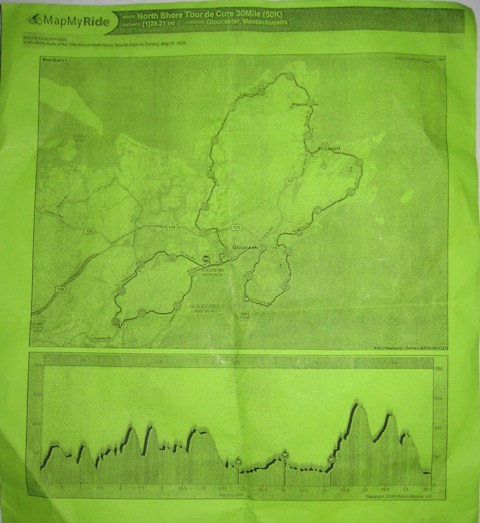
Here's a photo of the map they gave me at registration, that sat tucked away in my jersey pocket during the ride:

It was also available online prior to the event. So the night before, I studied that profile very carefully. Sitting there in the dim light of my bedside lamp, I came up with a simple plan: ride with moderate intensity in miles 1-12, pedal nice-and-easy on miles 13-21 (enjoying the spectacular scenery), then use all that saved energy for the tough-looking miles 22-30. Three sections, three movements ... it was to be symphony of a ride.
As I walked to the Gloucester High School gym to register, the 62 and 100 milers were gathering at the start line to begin their rides, which left an hour before mine. Making my way across the lot, the cleats of my cycling shoes hit the pavement at such awkward angles. Unfortunately there's no graceful way to walk with clipless pedal cleats! It's kind of funny, really ... the more serious we cyclists become, the more the bicycle transforms us in such strange ways. We become like sea-encrusted sailors, more comfortable in our chosen element than on land.
The gym was a beehive of activity, with cyclists pinning numbers on their jerseys and filling out donation forms. Walking up to the registration table, I turned in the donations I'd collected, received my number, chatted with a few other cyclists, and then went back to my car to prepare for the ride.
If you're like me, then you love packing-lists! So for all you list-enthusiasts out there, here's what I stuffed in my small seat bag for the ride:
Tire repair kit (spare tube, three tire levers, patch kit)
Small Allen-Wrench tool (you never know what can come loose on a long ride)
Eyeglass screwdriver (a must for all who wear glasses)
Five cereal bars (I only ate one, but it's nice knowing you've packed extra goodies)
Digital camera
Swiss Army Knife (with the Phillips-head screwdriver feature, rather than the usual corkscrew)
Wallet
Cell phone (with the Tour de Cure rider support number programmed in)
Car keys
On my bike were two water bottles; in my cycling jersey's rear pockets were the route map and two paper towel squares; and on my wrist was my Road ID band. Oh, and of course I wore my helmet, cycling gloves, cycling jersey, and cycling shorts.
Around 7:45 am, I began to make my way to the line for our 8:00 am start. In the back of my mind were Tour de France Commentator Phil Liggett’s words-of-wisdom:
“The smartest place to ride is at the front of the pack … the back is where all the trouble happens.”
Now this ride was not a race, and no one drafts off other riders or forms a tightly packed peloton in a charity ride. But still, I do like the feeling of staying in a steadily moving group and having others behind me. So I positioned myself close to the start-banner.


Looking back from the line, it was tough to get a feel for how many riders were there. But just before we were about to leave, I would guess there were about eighty or so.
Around 7:55, a well-spoken man thanked all of us for being at the Tour de Cure and talked a bit about his own life with diabetes. It was great listening to him ... he really reinforced why we were riding on this special day. Then the event organizer went over some safety rules (including "be careful, there's a drawbridge on the route that doesn't like bicycles"), a young woman sang the national anthem ... and then we were off!
Before I write anything further, a note about the photos: other than at the rest stops, I didn't take any pictures during the ride itself. Knowing me, that would have stretched the ride from two hours to around four! Besides, I wanted to simply enjoy riding, without feeling tempted to stop and snap photos at all the scenic points. After the ride though, I drove the route by car, which is where I took all these pictures. So just imagine lots of riders on these roads when you look at them!
For the first mile or so, we were led out of town by police escort. Gloucester has such a unique and tough kind of beauty to it. There are very few trees, and tightly-packed clapboard houses hug the winding and hilly streets. I really love it...

As we made our way into the greener outskirts, the thrill of beginning a long ride really hit home. Wheels were whirring all around me, gears were shifting in unison at each climb ... and although it wasn't a race, riders still jockeyed for position as they settled into groups that matched their preferred speed.
The first third of the ride wound its way around the very tip of Cape Ann, up and over rolling hills on beautiful tree-lines roads, and past old homes with views of the sea breaking through the trees now and then.


I especially loved riding through the little village of Lanesville, with its tiny post office.

Arrows painted on the road indicated where to turn (each color for a different mileage route).


It looked like they were painted with some permanence, which I think is really cool. That means that all year long those arrows are just cryptic symbols, until a special day in May when we cyclists magically give them meaning and direction. I'll have to go back in a month and see if they're still there.
We soon passed through the historic town of Rockport...

...and then entered a more moderate stretch of rolling hills before arriving at the first rest stop around mile 15. Fifteen miles is easy for me, but I was developing some soreness in the inside of my right leg ... which was odd, because I ride fifteen miles on my morning ride all the time. I decided it had to be because of some unnoticed tension in my position on the bike, caused by being out of my usual element. So the rest stop gave me a chance to stretch, drink some Gatorade, and eat a banana the volunteers had set out (very kindly donated by
Lull Farm).

I remember reading somewhere to be careful at rest stops: don't stay too long or eat too much! Otherwise, you'll loose your momentum. So after about five minutes or so, I hit the road again for the middle section of the ride, concentrating on pedalling powerfully but keeping my legs relaxed. It worked. Within a mile or so, the soreness in my right leg faded.
This middle section was breathtaking in its beauty. The only thing separating me from the Atlantic Ocean was a rocky coastline and one extraordinary road...


The scenery reminded me of the fog-covered moors you read about in Sherlock Holmes novels like The Hound of the Baskervilles. Riding along that stark landscape, I thought of the "Fantasia on a Theme of Thomas Tallis" by Ralph Vaughan Williams, with its wide open modal harmonies and rich string texture. So mysterious and intensely beautiful.
As the road gradually turned to the right...


...we made our way back into the center of Gloucester, riding along its historic harbor, past the Crows Nest bar (made famous by the book "The Perfect Storm"), and by the
Gorton's Seafoods headquarters (as in Gorton's fishsticks!).
The route soon took us back near where we began, by the Fishermen's Memorial...

...and on to Rest Stop #2. I didn't take many photos at this stop, but here's one looking up the road at some cyclists who had just pedaled away...

I had half-of-a-banana, ate one of my cereal bars, drank some incredibly refreshing Gatorade (next time, I'm filling one of my water bottles with Gatorade!), and then took off for the biggest hills of the ride. This is the section I'd kept in mind for the entire trip so far, telling myself: "take it easy ... don't forget the hills in miles 22-23."
The first climb hit quickly, and it was steep. The man riding ahead of me soon dropped back to ride slower, saying "this hill's a killer!" I'd been preparing for these hills for so long though, that even though it was steep, it didn't feel bad at all. I've taught myself that part of being a good cyclist is learning to love the hills ... even the most vicious, leg-burning, plus-10%-grade monsters (and this one wasn't nearly that bad). It's where the best stories of the ride are created.
Fortunately, I was able to stay focused and patient, concentrating on taking advantage of the rhythm of each hill by relaxing my legs slightly on the flatter sections and staying in a low enough gear to keep my cadence steady on the steepest slopes. And before I knew it, I was up and over!
We then turned right onto a very wooded and curvy road that headed mostly downhill. I was feeling great. I looked at my cycling handlebar computer -- twenty-five miles were behind me, only five to go. I figured we'd passed the biggest hills of the ride, so I thought: what the hell ... let's crank up the speed. I shifted into a higher gear, passed a couple of the riders ahead of me, and was zipping happily along when the road turned to the right ... and there it was.
A hill. A really steep hill.
It was the kind of hill that has no personality whatsoever. No false flats, no curves ... all it did was go UP. It's a wonderful thing really, because a hill like that is such an honest sort of monster. It doesn't try to lure you closer by rolling out a few gradual inclines. It's just there, standing in your way.
A rider near me said "yeesh, what a hill!", which made me feel better ... I wasn't alone in my thoughts. And really, I should have been prepared. All I saw on the profile sheet were the longer hills around mile 23; the smaller bump on mile 26 just hid innocently in their shadow. But after the initial shock, I got down to business. I shifted into my absolute lowest gear, relaxed my shoulders to make breathing easier, and began to climb.
Life takes on a surreal kind of simplicity on a steep hill. There's no music running in your head, no worries ... it's just you, the hill monster, your bike, and your legs -- which become entities all their own after a while. Sometimes they burn and hurt, but that's really just the hill monster trying to communicate with you. If you panic, the monster speaks even louder ... so the key is to stay focused and relaxed. Take your time, breath normally, enjoy the sensation of the road beneath your tires, and lull the monster to sleep as you continue steadily upwards ... higher and higher ... until ...
You've done it! And wow ... what an amazing feeling that is.
So to the Mile 26 Monster, I'm really glad I met you. You were scary at first, but I made it up and over your summit, and you gave me a good story to tell.
From there on it was pretty much all downhill ... beautifully, wonderfully downhill. We eventually broke through the trees and onto a road with marshes and coastal scenery on each side, and soon we were back in town, near the Fishermen's Memorial ... almost home.
We crossed the charming "drawbridge that doesn't like bicycles"...

...and then turned back onto the same street near the high school that we rode on two hours ago, but this time in the opposite direction. Up ahead, I could see the reverse side of the START banner, and it read:

Crossing under that banner was an other-worldy sensation. I felt like I was a time traveler returning home. Gloucester High School looked the same as it did when I left it, and some of the same volunteers were gathered around the finish area (giving us a big cheer as we arrived). But we riders had changed.
We had been transformed and inspired by two hours on
the road.
The road
that revealed oceans, forests, and storied old villages.
The road
where the miles fell one by one, reminding us "you can do this".
The road
where we learned to love the hill monsters.
The road
where our fellow cyclists were so kind, looking out for one another.
The road
where journeys were made and epics created.
The magical,mysterious,
wonderful road.It was an incredible ride.
As I walked my bike around the end area, I checked in with the volunteer recording the number of each finishing rider (we were told that if we didn't report in at the end, the organizer would come to our homes to be sure we were o.k.!). After that, I joined the volunteers in applauding some of the other 30-milers coming across the line. I then sent a few text messages and headed into the gymnasium for some post-ride goodies. Inside, the organizers were distributing free Tour de Cure t-shirts and bags to riders....

At the end of the free-gift line was a table for filling out a post-ride survey. My favorite question was:
which rest stop did you like the best? I think I selected Rest Stop #1, but I can't remember for sure. They were all very much appreciated!
It was now around 10:25 or so, and it looked like lunch was going to start around 11:30. So I had some nice time to relax. Other cyclists were walking around too, meeting with family and friends, or just enjoying the feeling of a completed ride.

Here's a nice photo of my bike, post 30-mile adventure:

It did so well! No mechanical problems, and it even received a compliment from an organizer for its beautiful blue color.
I walked my bike across the parking lot to put back in my SUV zipcar ... which, now that I think about it, was kind of funny. I could have easily ridden it, but I guess subconsciously I figured my bike deserved a rest!

I then visited the sponsor booths and collected literature on diabetes. Riders from the various routes were still coming across the line, and the volunteers gave a cheer for them all. I talked with one of the volunteers for a bit, and she said she'd been out since 5 a.m. that morning, but she wasn't complaining at all. They were fantastic.
I changed out of my cycling clothes in the restroom, into shorts and a comfortable shirt ... and before long it was time for lunch!
First I had an awesome cup of clam chowder donated by
Lobsta Land, a local restaurant. It's the kind of chowder you can only find here in New England ... the perfect blend of clams, cream, and potatoes ... so subtle and smooth. I then had some always-good
Papa Gino's cheese pizza. There were also wonderful-looking dishes donated by
Cafe Barada, which my food allergies unfortunately kept me away from. But they sure looked great!
While eating, I listened to the speakers give out awards for the highest fundraising totals. Asking people for money is never easy, so hearing about these incredible fundraisers was really inspiring, and a great learning experience for the future.
But all good things must come to an end ... so soon it was time to say goodbye and head for home. I was actually looking forward to the drive though -- retracing the route by car to take photos, and having some quiet time to reflect on this great day.
So a huge THANK YOU to all the organizers, the wonderful speakers, the generous sponsors, the hard-working and cheerful volunteers, the inspiring "red riders" (riders who identified themselves as having diabetes), and all the other cyclists. The North Shore Tour de Cure was a ride I will never forget.