Sunday, January 24, 2016

2015 Tour de France Notebook -- Stage 3

For summary of this project, click here.

Here is my Stage 3 notebook entry:


Shorthand translation:

The stage began seemingly so peaceful in Antwerp.  But the anticipation of the last climb -- the Mur de Huy -- kept everyone nervous.  It reached a breaking point around 53K from the end with a terrible crash.  So many riders went down, including Fabian Cancellara in yellow.  The officials stopped the race -- amazing and unprecedented -- which was the right call.  But I loved seeing Cancellara still making it to the end with his teammates patting him on the back,

Saturday, January 23, 2016

2015 Tour de France Notebook -- Stage 2

For an overview of this project, click here.

Here is my Stage 2 notebook entry:


Shorthand translation:

An incredible stage today.  Beginning in Utrecht (which seems like so long ago now at the end of the stage) with a ribbon-cutting ceremony, and then it was onto the rain and crosswinds.  Twice winds broke up the peloton -- the final time into three groups which stayed that way till the end.  Caught in the back group:  Nibali, Quintana, and Degankolb.  Greipel pulled ahead of Cavendish at the end (and Sagan got an amazing second place despite getting a flat tire late in the race).  And Cancellara came in a great third for the four second time bonus.

Monday, January 18, 2016

2015 Tour de France Notebook -- Stage 1

For an overview of this project, click here.

Here is my Stage 1 notebook entry:


Shorthand translation:

An exciting and amazing stage -- all under yellow umbrellas in the 100-degree weather.  The eventual winner, Rohan Dennis of the BMC team, chose to start early and set a world record time that no one could beat.  Some highlights: seeing the Dutch rider Tom Dumoulin race amid the roar of the crowd in Utrecht, cheering on Fabian Cancellara (didn't quite make it into 1st, but nice to see him back in action), and seeing the amazing architecture of this very modern city with beautiful bridges and old buildings mixed in with the new. 

Sunday, January 10, 2016

2015 Tour de France Shorthand Notebook -- Overview

I love Tour de France projects.  In 2010 and 2011 I painted nightly watercolors after watching each stage on TV (which you can see in the menus at right).  For the next three years, simply watching the tour was a project in itself, with my busy summertime work schedules!

But in the summer of 2015, I decided to do something new.  I combined my love of writing shorthand with sketching to create this:


What you're looking at is a 6'" x 8" spiral bound drawing notebook, which happens to be the same size as a standard Gregg Shorthand steno pad.  I stuck some yellow card paper over the cover and then added a Tour de France postcard my mother found on eBay.  I cut the paper to shape with a t-square ruler and an X-Acto knife and then attached it and the postcard to the notebook using Scotch double-sided tape.

After watching each stage in television, I opened up a fresh page of the notebook and got to work.  Here's one of the pages, so that you can see what I did each night:


Every evening I settled into a fairly regular process...

First, I wrote the stage number and geographical information at the top of the page with a felt-tipped pen.  Then I decided where I would place my sketch ... sometimes at the top, sometimes at the bottom, and other times in a corner.  After I finished the sketch using colored pencils and the felt-tipped pen, I then wrote the stage results using a ball-point Parker Jotter.  Next, I made evenly-spaced lines on the rest of the page using a mechanical pencil and a t-square ruler.  Last but not least, I wrote a summary in shorthand using the Jotter.  I didn't plan much; I basically just wrote whatever came to mind.

What is Gregg Shorthand?  Here in the U.S., it was the most widely used written system to record the spoken word from the early 1900's until shorthand began to sink into obsolescence in the 1980's.  My grandmother learned Gregg in High School and used it throughout her life.  From the first time I saw my grandmother write it, I thought shorthand was beautiful, fascinating, mysterious, and fun.  So in 2002 I decided to learn it.  By 2004 I had taught myself the basics from a used 1960's textbook (the Diamond Jubilee version of Gregg, for those of you in-the-know).  I'm not an experienced enough shorthand writer to do dictation yet, but I can keep personal notes fairly well.

In the next 21 posts, I'll share each page of my 2015 Tour de France Notebook and translate the shorthand for you.  I think the sketches tend to get a little better with each stage.  When you're doing a sketch and writing an entry each night one can't be too self-critical.  That was actually all part of the fun.  I loved spending time with this little notebook each evening of the 2015 Tour.

Enjoy!

Sunday, May 31, 2015

Spring on the Brompton

And I'm back!

During this year's impossibly long and rough winter here in Massachusetts, dreams of cycling adventures helped see me through to the beautiful months of spring.  If my early season Brompton rides are any indication, it's going to be a good June, July, and August ahead.


Along with some great rides in my neighborhood, such as on the Neponset River Trail next to the old Baker Chocolate Factory....


...early spring warm weather gave me a chance to take my Brompton with me on some trips out the the Berkshire Hills of western Massachusetts, where I rode the Ashuwillticook Rail Trail.  Running from Pittsfield to Adams, this 11-mile paved path features some beautiful lakeside views of Massachusetts' tallest mountain, Mt. Greylock...


...as well as waterfalls, rocky outcroppings, and nice cycling infrastructure.


And just last week, my Brompton was in all its inter-modal-transportation glory as I took it on the historic Greenbush Old Colony Line train (recently re-added to Boston's Commuter Rail system) to the South Shore town of Scituate.


A bike path leads from the station...


... alongside a vast salt marsh, with seaside homes lining the ocean on the other side...


... on to the harbor.


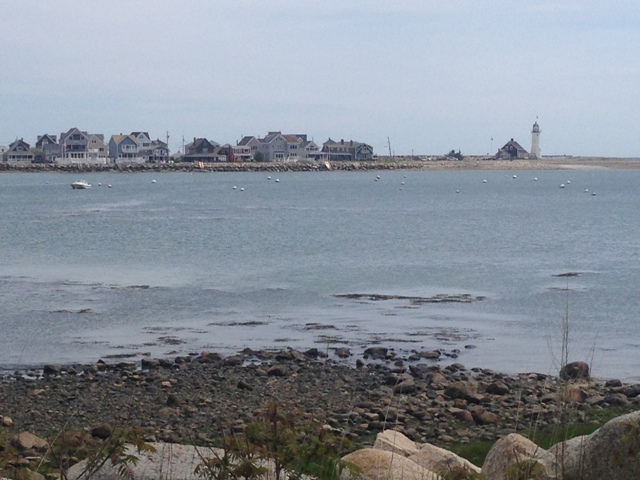
My goal for the ride was Scituate Light on the opposite end of this little bay.


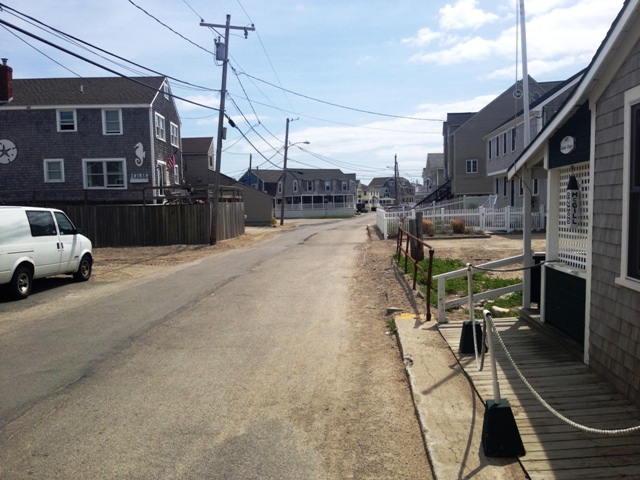
Riding out on the neck took me by picturesque summer cottages...


...before reaching the old lighthouse on the end.


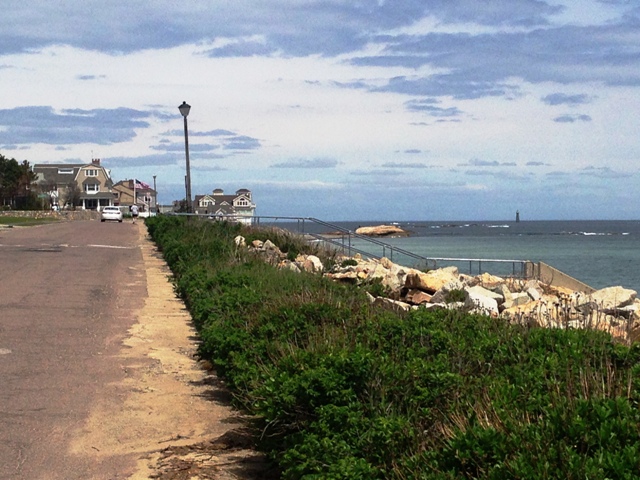
Riding a bit further up along the Scituate coastline, I reached the second lighthouse of my journey -- the remote and mysterious Minot Ledge Light.  Here you can see it to the right of this photo, completely surrounded by the rough waters of the cold North Atlantic.


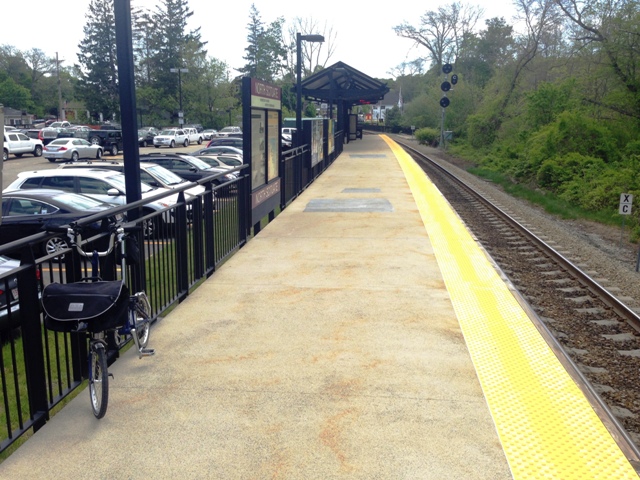
And then it was time to ride to the North Scituate train station and head home...


...with my Brompton tucked into the seat beside me.

Thursday, November 27, 2014

The Nashua River Rail Trail

All is quiet on the Nashua River Rail Trail.


Even on days warmer than the cold November morning of my ride, I have a feeling that a sense of peace always prevails on this path as cyclists, rollerbladers, dog walkers, and strolling families make their way along the 12.2 miles from Ayer, Massachusetts to Nashua, New Hampshire.

The trail's namesake winds in and out of view...


... and after seeing a few colorful trees at the start of the path...


... the forest quickly turns into to a late-autumn landscape of pines and leafless trees.


It's a friendly trail.  This pit-stop comes into view just as one crosses the Massachusetts-New Hampshire state line:


... and the quaint town of Pepperell makes for a nice resting point along the way.


All of these things are enough to make this trail special.

But the Nashua River Rail Trail is more than just a beautiful path.  It tells a story.

In 1981, the last train came down the tracks that used to lie along this path, ending a 133 year run of both freight and passenger service.  According to a plaque along the route, the glory years of passenger service were between 1900 and 1911, when the line was part of the Worcester, Nashua and Portland Division of the Boston and Maine Railroad (in case you like train schedules as much as I do, I left this photo hi-res, so that you can zoom in).


During those heyday years, a night train from New York City to Bar Harbor, Maine used to barrel through these woods.  Must have been an amazing sight.

Although the tracks are now gone, mile markers still exist today, with the original designations beautifully restored. Heading north on the path, "P" represents the miles to Portland...


... and riding south, the "W" indicates the miles to Worcester.


Seeing those mile markers and moving at the contemplative pace of a bike ride, it's easy to put oneself into the seats of those old trains -- looking out the windows at these same woods, sitting beside passengers from a time long since faded into an unrecorded past.  One can almost hear the sounds from a century ago: the clickity-clack of the cars, the steam whistle, and the hiss of that great iron engine. Murals under bridges recall the history of this remarkable place with colorful flair.


Riding my bike further and further along the Nashua River Rail Trail, I imagine that the unrecorded narratives of those passengers from long ago may not be so unrecorded after all. Their stories must exist somewhere, maybe in the attics of faraway houses, in dusty shorthand journals, describing the mystery and beauty of a night train from New York City to the rocky coast of Maine.

Tuesday, November 18, 2014

The Brompton Toolkit

It must be fun being a Brompton engineer.  Take for example the beautifully designed Brompton Toolkit.


Need to tighten a bolt or repair a flat tire?  Just pull on the little ring, remove the outer shell, and here's what is magically revealed:


On one side is a ratchet wrench set, with magnetically secured double-ended bits fitting every hex screw on the bicycle, as well as flathead and Phillips screwdrivers.  Built into the ratchet's handle is a 15 mm wrench, and a self-adhesive tire patch with sandpaper is tucked into a space at the end of the toolkit.


On the other side of the toolkit are two tire levers, into which are carved 8 mm and 10 mm wrenches, as well as a spoke hook.


I actually didn't even know about the spoke hook until I happened across mention of it online.  So perhaps there are other things this amazing little device can do that I haven't even figured out yet!

Now, you might be saying: ok, that's fine, but where do you store it while riding?  That's where the truly ingenious part comes in.

Let's have another look at the toolkit all back together again:


Both ends of the lightweight toolkit are capped with hard rubber, the top of which flares out just a bit.  Like all bicycles, the Brompton's frame is hollow.  But unlike almost all other bicycles, on the Brompton you have access to that hollow space.

Have you figured it out yet?  That's right, into the frame it goes!


The rubber flare and a magnet keep the toolkit perfectly secure with no movement or rattling whatsoever.  When you open the bike into riding position, the frame closes over it and you have no idea there's a toolkit inside.  Fantastic!  I used the toolkit on my first few rides to make minor adjustments, and now it's wonderful just knowing it's always there.